
MEASUREMENT PROTOCOL FOR ALL OUR ACTIVE STUDIO MONITORS
– Environment: anechoic room, temperature: 23 ± 2 °C
– LEVEL and ROLL-OFF on CAL position
– Mains power supply: 230 ± 2 % Vac
| Data | [Unit] | Input signal | Description |
|---|---|---|---|
| Potential peak power | [W] | Hann-burst of 1 cycle Frequency: middle of the bandwidth emitted by the driver in question | Amplifier without limiter with dummy load resistors of the same resistance as a the nominal impedance. The squared peak output tension is divided by the resistance value to give the potential peak power. |
| Max RMS power | [W] | Sinus Sweep @ clipping +6 dB | Done on the complete Monitor. Measurement of the voltage on the connections of each driver. The "Max RMS Power" is the squared value of the Max RMS voltage (Tau = 35ms) divided by the nominal impedance of the transducer. |
| Input impedance | [Ω] | Sine 20 Hz-20 KHz | A resistance is connected in series with the input of the monitor. The input impedance is equal to the resistance when the attenuation due to the resistance equals -6dB. |
| Input sensitivity | [Vrms] | Pink noise filtered to the announced "Bandwidth at -6dB" | The RMS voltage of the input signal is measured to obtain 90dB SPL at 1m in the axis of the speaker. This value is then multiplied by 3.16 to extrapolate the value for 100dB SPL @ 1m. |
| Input overload | [Vpp] | Sine 20 Hz-20 KHz | The maximum peak-to-peak voltage of the input signal is reached as soon as the output signal of the input circuit is clipped |
| Continuous max SPL@1m | [dB] | PN M 1040 weighted noise* Level: Limiter led flashing +6 dB | The maximum SPL @ 1m on axis is retained in RMS with a time constant of 250 ms (fast). |
| Short term max. SPL@1m | [dB] | PN M 1040 weighted noise* Level: Limiter led flashing +6 dB | The maximum SPL @ 1m on axis is retained in RMS with a time constant of 35 ms (250db/s). |
| Peak max. SPL@1m | [dB] | PN M 1040 weighted noise* Level: Limiter led flashing +6 dB | The absolute value (positive or negative) of the instantaneous peak SPL @ 1m on axis is retained. |
| Background noise @ 1m | [dBA] | Shorted input | The maximum value is obtained by successively measuring the weighted "A" SPL emitted at 0.1m by each transducer. 20 dB are then subtracted to extrapolate the result to 1m distance. |
| Signal to noise ratio (S/N) | The signal to noise ratio is the difference between the continuous max SPL @ 1m and the background noise @ 1m. | ||
| Bandwidth at -6dB | [Hz] | sine sweep 10 Hz-40 KHz | The bandwidth is measured at 90dB @ 1m on axis in between the lowest frequency and the highest frequency crossing 84 dB. |
| SPL tolerances | [dB] | sine sweep 10 Hz-40 KHz | The SPL tolerances are the admissible variations in dB of the frequency response within the announced bandwidth. |
| Phase tolerances | [°] | sine sweep 10 Hz-40 KHz | The phase tolerances are the admissible variations in degrees of phase response within the bandwidth. |
| Dispersion (H x V) | [°] | Pink noise 30 Hz-15 KHz | The speaker is oriented around an axis going through its SPL origin ** The limits of the dispersion angle are reached as soon as an octave band is attenuated by -6dB compared to the on axis SPL. The angle is given for the horizontal and vertical planes (HxV). |
| Directivity Factor | [.] | Log Chirp | The directivity factor is the on-axis pressure divided by the acoustic pressure radiated in every direction. The typical result is shown on a graph. |
| Distortion THD | [dB] | Sine sweep | A sliding sine signal is adjusted to obtain 90 dB @ 1m. The level of total harmonic distortion is the RMS value of the SPL of the sum of all upper harmonics. The typical result is shown on a graph referenced at 90dBspl. |
| System | [Nb of ways] | Number of drivers with different bandwidths. | |
| Crossover frequency | [Hz] | Frequency at which both drivers have identical SPL (typically -6 dB). | |
| Woofer ext. diam. | [mm] | The dimension is the diameter of the circle circumscribed around the transducer overall. | |
| Woofer ext. diam. | [in.] | The dimension is the diameter of the circle circumscribed around the transducer overall. | |
| W. diaphragm diam. | [mm] | The dimension is the average diameter of the surround suspension. | |
| W. diaphragm diam. | [in.] | The dimension is the average diameter of the surround suspension. | |
| Medium ext. dim. | [mm] | The dimension is the diameter of circle circumscribed around the transducer overall. | |
| Medium ext. dim. | [in.] | The dimension is the diameter of circle circumscribed around the transducer overall. | |
| M. diaphragm diam. | [mm] | The dimension is the average diameter of the surround suspension. | |
| M. diaphragm diam. | [in.] | The dimension is the average diameter of the surround suspension. | |
| Tweeter ext. dim. | [mm] | The dimension is the diameter of circle circumscribed around the transducer overall. | |
| Tweeter ext. dim. | [in.] | The dimension is the diameter of circle circumscribed around the transducer overall. | |
| T. diaphragm diam. | [mm] | The dimension is the average diameter of the surround suspension. | |
| T. diaphragm diam. | [in.] | The dimension is the average diameter of the surround suspension. | |
| Dimensions W x H x D | [mm] | The dimension of the cabinet without connectors, grilles, brackets, etc. | |
| Dimensions W x H x D | [in.] | The dimension of the cabinet without connectors, grilles, brackets, etc. | |
| Net Weight | [Kg] | Weight of the unboxed monitor without packaging. | |
| Net Weight | [lbs] | Weight of the unboxed monitor without packaging. | |
| Mains voltage | [V, ±10 %] | During all measurements the mains voltage is kept within ± 2% of the nominal value. The loudspeaker must operateproperly within voltage variations of ± 10%. |
|
| Mains max DC offset | [V] | An adjustable DC offset is added to the AC mains voltage. The maximum is reached as soon as a disturbance exceeds the tolerance. |
|
| Standby consumption | [W] | The standby power consumption is measured in RMS at the mains input and with 12 V phantom voltage on the XLR input and with the input short-circuited. | |
| Quiescent consumption | [W] | Same as above but with no phantom voltage. | |
| Max continuous Power | [W] | PN M 1040 weighted noise* Level: Limiter led flashing +6 dB | The maximum continuous power is given by the manufacturer of the transformer. |
| RMS continuous consumption | [W] | PN M 1040 weighted noise* Level: Limiter led flashing +6 dB | RMS electrical consumption measured during the signal reproduction. |
| Max Relative humidity | [%] | Relative humidity not to be exceed during the storage and the use of the product. | |
| External temperature range | [°C] | Maximum and minimum temperature not to be exceeded during use of the monitor and to maintain good listening quality. | |
| * PN M 1040 weighted noise | Pink noise with statistical music weighting | ||
| ** Origin of SPL | Is the point beyond which the attenuation is proportional to the distance. This is determined by measuring the distance corresponding to 6 dB attenuation and subtracting this distance from the distance of the measurement point. | ||
| PSI Audio, March 2026 | Methods and figures can be updated anytime if improvements are made either in products or methodology |
For more than 30 years, PSI Audio has used a dedicated test noise designed to simulate music when measuring maximum SPL and evaluating loudspeaker reliability. This approach has provided consistent and meaningful results and has allowed us to develop and refine our monitoring systems over decades.
As measurement techniques evolve and new standards emerge, it is important to continuously refine how performance is characterized. The AES75 standard represents an important step in this direction by introducing a methodology that aims to better reflect real-world listening conditions. We therefore see AES75 as a valuable opportunity to further improve the way maximum linear sound levels are quantified and communicated.
One of the fundamental challenges in defining the operating limit of a loudspeaker is determining what truly limits performance under normal use conditions. For loudspeakers, a simple increase in distortion is not always the most relevant indicator. In practice, other mechanisms – such as mechanical limits of the transducers or thermal constraints – can appear earlier and determine the usable output level.
The AES75 standard addresses this challenge by defining the maximum output level as the point where compression reaches 2 dB, regardless of frequency. In both active and passive loudspeaker systems, such compression may result from distortion, amplifier saturation, or mechanical or thermal limitations within the system. This makes compression a practical and meaningful indicator of the maximum linear operating range.
For this reason, we welcomed the AES75 standard, which uses pink noise weighted with a low-pass filter designed to approximate the statistical characteristics of music. This approach provides a practical way to evaluate loudspeaker performance under conditions closer to real program material.
One aspect of the current standard, however, is that the high-pass filtering is left to the manufacturer to define and document. While this flexibility may be useful in some contexts, it can make direct comparisons between different loudspeakers more difficult, especially when different manufacturers adopt different filter settings.
Professional sound reinforcement systems often require test signals adapted to specific musical styles or environments. However, in many common applications—such as cinemas, multipurpose venues, domestic listening environments, and especially recording, mastering, or broadcast studios – a statistical representation of music remains the most meaningful and repeatable test signal.
Our analysis of music spectra shows a strong correlation with IEC-60268-1 noise. In this model, the high-pass weighting corresponds to a fourth-order Bessel filter at 20 Hz, resulting in approximately –12 dB at 20 Hz and –4 dB at 40 Hz. This weighting provides a realistic representation of how low-frequency energy is typically distributed in music.
Spectral analysis of music also shows a peak factor greater than 6 dB, meaning peak power can be roughly four times higher than the average power. In practice, this corresponds to the maximum power being applied for approximately a quarter of the time.
Thermal behavior of loudspeaker transducers can be described by two main time constants. The first corresponds to the heating of the voice coil, typically between 0.5 and 2 seconds. The second corresponds to heat transfer from the voice coil to the surrounding magnetic structure, typically between 2 and 10 minutes.
To represent these dynamics realistically, we recommend a pulsed noise signal with a duration longer than 2 seconds and a repetition period shorter than 2 minutes. A practical example is a 40-second cycle consisting of 10 seconds ON and 30 seconds OFF.
In our internal protocols, this signal is referred to as:
Music-Weighted Pulsed Pink Noise (PN M 10/40)
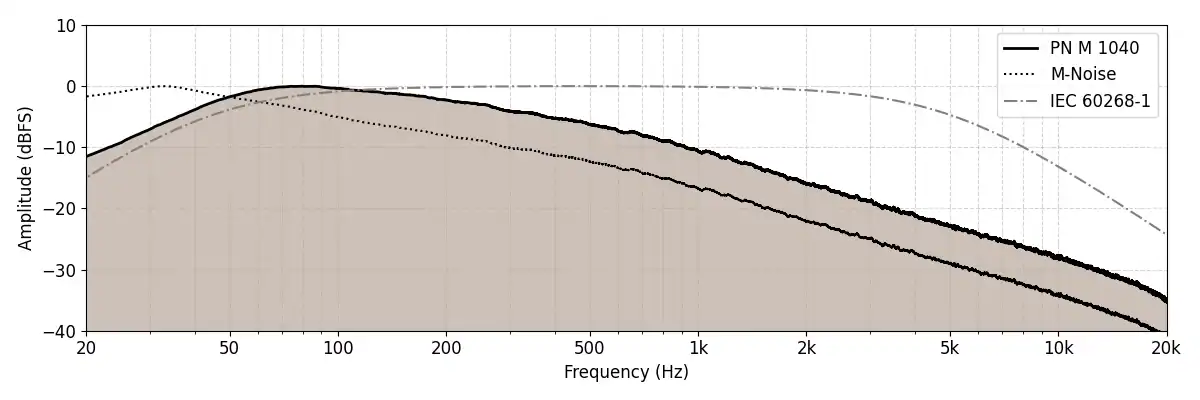
To validate this approach, measurements were first conducted in an anechoic chamber using the PN M 10/40 noise signal. These results were then compared with measurements performed in several real studio environments using both the same PN M 10/40 signal and a selection of music program material. The observed differences were consistently below 1 dB, confirming the strong correlation between this measurement method and actual listening conditions.
By combining long-standing measurement experience with evolving industry standards such as AES75, we continue to refine how loudspeaker performance is evaluated. This ongoing development supports our goal of improving our products and providing users with transparent and meaningful specifications when selecting monitoring systems.